
Why Heritage Hills is different
Heritage Hills was Oklahoma City's first local historic district, zoned Historic Preservation (HP) in 1969 and listed on the National Register in 1979. It runs south of NW 21st Street between North Walker and North Robinson, with an arm west to Classen along NW 14th and 15th Streets. Heritage Hills East, east of Robinson, is its own district under the same rules (OKC Preservation Standards and Guidelines).
In an HP district, work that alters the exterior of a building or site needs a Certificate of Appropriateness before it starts (OKC code § 59-7250). A permanent track on your fascia is an exterior change, so we plan for one.
What the city's lighting guidelines say
The city's Preservation Standards and Guidelines (revised October 2019) have a lighting section. The parts that matter for permanent lighting:
- New fixtures where none existed should be unobtrusive, conceal the light source and direct light toward the building (3.11.10).
- Fixtures on the building must be compatible with the historic character of the area and match the style and period of the house (3.11.2).
- Historic porch lights and original fixtures should be kept and maintained. They can be rewired to use modern bulbs (2.5.4, 2.5.7).
- Lighting a facade to highlight its ornamental detail may be permitted. Fixtures must be small, shielded and aimed at the building rather than the street, to keep glare off neighbors and people walking by. Incandescent-style white light is encouraged, and exposed conduit and overhead wiring are not permitted (2.5.39).
- Unobtrusive foot-lighting along pathways may be installed, and solar fixtures are encouraged (2.5.9). Foot lights along walks are preferred over adding pole-mounted gas lights in front yards (2.5.40).
- Landscape elements in back yards that can't be seen from any street or neighboring property, and are under six feet tall, aren't subject to review unless they need a permit (2.5.3).
The guidelines don't mention holiday decorations, so we don't assume either way. A permanent install is designed to pass review.
Staff can approve it, if it meets the guidelines
Lighting on the building that meets sections 3.11.8 to 3.11.10 of the guidelines, and site lighting that meets the landscape sections (2.5.11 to 2.5.40), can be approved administratively by city staff, without a full Historic Preservation Commission hearing. Staff can still send an application to the Commission if they think it should be heard there. When an application does go to the Commission, it has 65 days from the first hearing to rule (OKC zoning code § 59-4250).
How we design for it
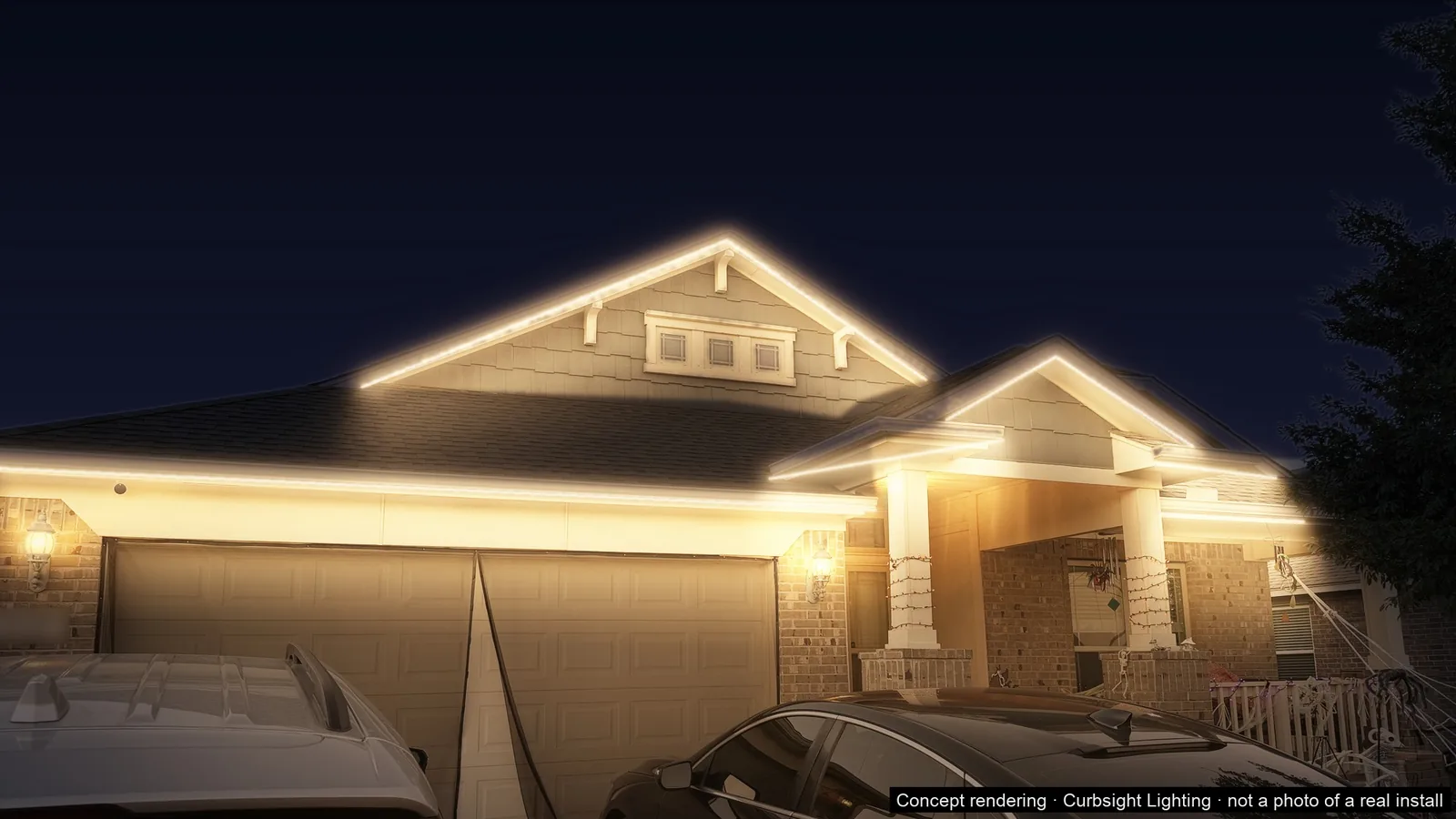
- Hide the source. A warm continuous line tucked under the soffit shows the light, not the LEDs, which fits concealing the light source and directing light toward the building.
- Warm white, period-appropriate. About 2700 K, close to the incandescent white the guidelines encourage, and dimmed so the brick and stone look like themselves.
- No visible wiring. Exposed conduit and overhead wiring aren't permitted, so the wiring is routed out of sight.
- Restraint on the front. The guidelines ask that landscape features stay restrained on the fronts of buildings, so the public face of the house stays visible. We light the roofline and the entry, not the whole yard.
- Keep the original fixtures. We work around historic porch and yard lights, not over them.
- Path lights and the back yard are the easy part: unobtrusive path lighting and lighting the street can't see.
What we bring to the application
- Photos of the house as it is today
- A night rendering of the proposed lighting
- Spec sheets for the track, the lights and the power supply
- A mounting detail showing the fascia or soffit mount, with nothing attached to the roofing
- A plan of what's lit and what stays dark
Before we submit anything, we confirm the current requirements with the city's historic preservation staff. Other OKC historic districts, including Mesta Park, Crown Heights, Edgemere Park, Jefferson Park, the Paseo, Putnam Heights and Shepherd, use the same citywide standards, so the same approach applies there.
Nearby: Oklahoma City and Nichols Hills. Related: historic homes and continuous-line lighting.