
The short version
| DIY kit | Professional install | |
|---|---|---|
| Cost | About $3 to $4 a foot for the lights, plus your time | $32 a foot for node lights, $100 for a continuous line, installed |
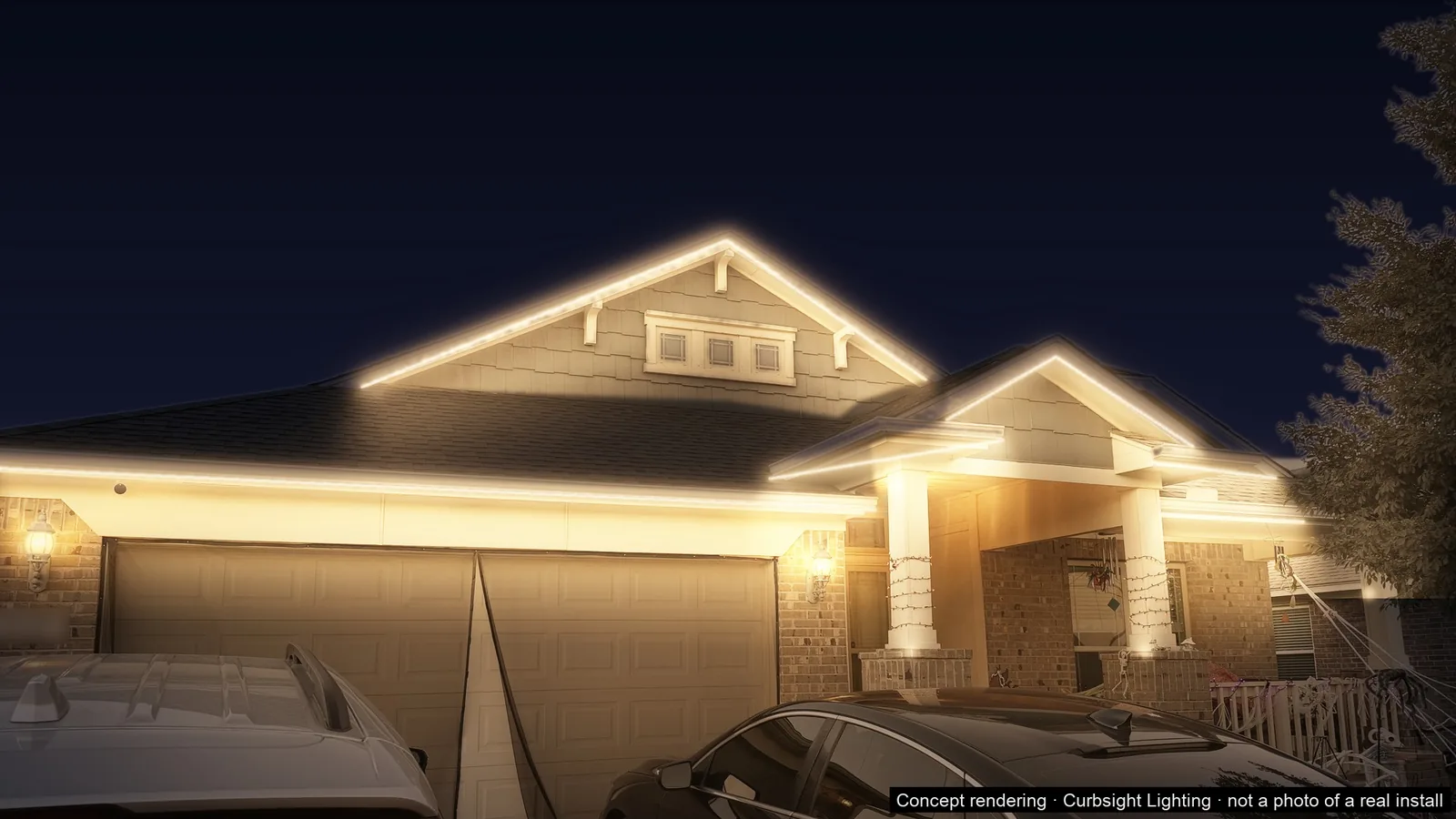
| Design | You decide where it goes as you go | Designed for your house first, and you see a night mockup before anything is ordered |
| Mounting | You, on a ladder | Mounted to the fascia or under the soffit, never through the shingles, with sealed cuts |
| Power | Plugs into an outlet you already have | Power planned for the run. Any 120-volt work is done by a licensed electrician |
| Warranty | The maker's product warranty. The labor is yours | The maker's product warranty plus 2 years on our workmanship |
| When something stops working | You troubleshoot it | You call or text 405-706-6042 |
Prices for kits move often. For a sense of scale, Govee's Permanent Outdoor Lights 2 Pro were listed at about $640 to $800 for 200 feet in early October 2026 (9to5Toys), which works out to about $3.20 to $4.00 a foot before any labor.
When the kit is the right call
- A simple, single-story roofline. Few peaks, few corners, and an outlet near where the run starts.
- You like projects and you're comfortable working on a ladder at the roof edge.
- You mostly want holiday color, and you're not after a particular look the rest of the year.
- Budget is the main thing. A kit is a fraction of the cost, and there's nothing wrong with that.
What a professional install adds
- A design. Which lines to light, what to leave dark, and what the house should look like on a normal Tuesday, not just at Christmas. You see it at night before you buy.
- The roof stays intact. Anything fastened through the shingles can leak and can void a shingle warranty. We mount to the fascia or tuck the track under the soffit.
- Power done right. Long runs, two stories and multiple zones need power planned along the way. Oklahoma's electrical license exemption covers low-voltage Class 2 circuits, so anything on 120 volts goes to a licensed electrician.
- One person responsible. The product warranty from the maker, plus 2 years on our workmanship. See the warranty.
- A continuous line. If you want one smooth line with no dots, see dots vs a continuous line.
Where DIY installs usually get hard
- Two-story eaves and steep rakes, where the ladder work gets serious
- Peaks and inside corners, where the track has to bend or be cut and sealed
- Getting power to the start of the run without an extension cord across the yard
- Wi-Fi that reaches the controller in the garage or the attic
Next: see continuous-line lighting in depth, or get a free night mockup of your own house with both looks and a price for each.